

Few supplements attract as much argument as creatine, and few deserve it less. For every confident claim that it is a miracle, there is an equally confident claim that it is hype. The unusual thing about creatine is that the question has a genuinely clear answer, because it may be the most heavily studied sports supplement ever made.
Does creatine actually work? On the specific outcomes it is meant to affect, strength and short bursts of high-intensity power, the answer from the research is yes, with a consistency most supplements never come close to. What makes that answer trustworthy is not any single trial but the sheer weight of evidence behind it.
What the Creatine Studies Show
Creatine monohydrate has been tested in hundreds of placebo-controlled trials over three decades. Individual studies vary: some report a large jump in bench-press strength, others a modest one, a few almost none, depending on the participants, the dose, and the training program. That spread is normal, and reading one study in isolation gives a distorted picture.
When the trials are pooled, the scatter resolves into a steady, positive signal. The average effect on strength and power is real and repeatable, even if it is moderate rather than magical. Creatine will not replace training, but across the body of evidence it reliably adds to it, which is exactly the pattern a well-supported supplement should show.
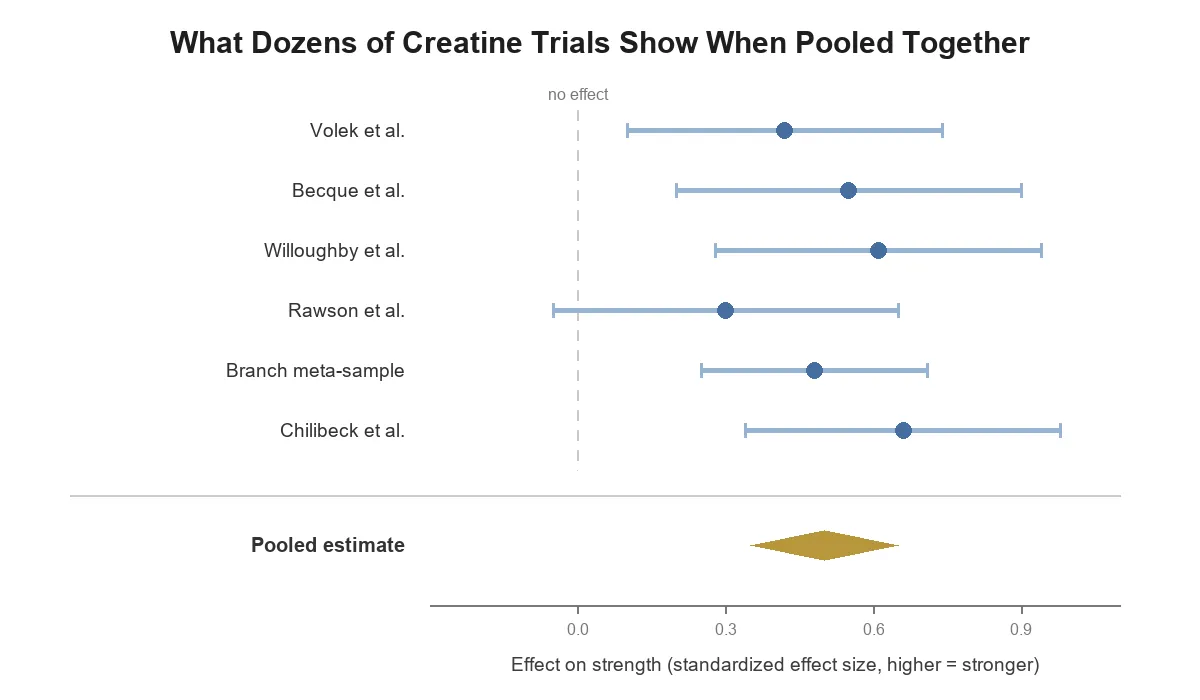
Individual creatine trials scatter; pooled together they show a steady positive effect on strength. Original illustration created for this article, royalty-free.
How to Read a Supplement Claim Without Getting Fooled
The tool that turns scattered studies into a trustworthy answer is the effect size, a standardized number that expresses how large a result is rather than merely whether it cleared a significance threshold. Pooling effect sizes across many trials is what separates creatine, whose benefit survives the averaging, from the supplements whose apparent effects vanish once the weak and the negative studies are counted alongside the flattering ones.
That habit, judging a claim by the whole body of evidence rather than the single loudest study, is exactly how research methodologists evaluate evidence for a living, including the team at https://www.researchgold.org/. Applied to the supplement shelf, it quietly explains why most products do not work and why creatine, unusually, does.
The Bottom Line on Creatine
For most people training for strength or power, creatine monohydrate is one of the few supplements the evidence genuinely backs: inexpensive, well tolerated, and effective at a modest but real level. The verdict holds not because one study was impressive, but because hundreds of them, added up, point the same way.